Analysis: Tuesday’s Nationwide Emergency Alert Test Is a Reminder of Why Radio Still Matters in Louisiana
At about 1:20 p.m. Central time on Tuesday, Nov. 17, radio and television programming across the country is scheduled to stop for roughly a minute while the Federal Emergency Management Agency, working with the Federal Communications Commission, runs a nationwide test of the Emergency Alert System. FEMA announced the final details Monday and stressed that no action is required by the public.
The message itself will be plain. According to the FCC’s public notice, the audio and on-screen text are designed to say: “This is a nationwide test of the Emergency Alert System, issued by the Federal Emergency Management Agency, covering the United States from 14:20 to 14:50 hours ET. This is only a test. No action is required by the public.” The times are given in Eastern, so Louisiana listeners should expect it during the 1 o’clock hour. Broadcasters may carry it in English, Spanish or both.
What will and won’t go off. The test is aimed at broadcast radio and TV stations, cable and satellite systems and wireline video providers, the groups the FCC defines as EAS participants. FEMA says cell phones will not buzz this time; Wireless Emergency Alerts were tested in 2023 and are not part of this year’s exercise. If severe weather or a real emergency happens Tuesday, FEMA and the FCC may postpone, with Dec. 3 set as the backup date.
Why run it at all? Federal law requires FEMA to test the national public alert and warning system at least once every three years. The point is to find broken links before they matter. Stations also have homework: the FCC requires participants to report through its EAS Test Reporting System within 48 hours whether they received and relayed the test, with more detailed data due by Jan. 4, 2027. Those reports are how regulators learn which receivers failed, which stations were monitoring the wrong source, and where the chain broke.
“During an emergency, every second is crucial,” FEMA Administrator Cameron Hamilton said in Monday’s release, adding that operational tests let the agency identify and fix potential issues before an actual emergency occurs.
The Louisiana angle. The timing is pointed. In just the last few days, Americans watched a rare FAA nationwide ground stop on Friday that federal officials tied to an overloaded communications system, a multi-day Microsoft 365 outage, and on Monday a system failure at United Airlines. In a state that measures its year in hurricane seasons, residents know the pattern: when power, internet and cell networks get stressed, a battery-powered radio is often the last line still talking. A nationwide test of the broadcast warning chain is not glamorous, but it is a check on the piece of the system that has to work when the fancier pieces do not.
For listeners, the takeaway is simple. If you hear the tones Tuesday afternoon, it is a test, and normal programming will resume within about a minute. It is also a good prompt to make sure there is a working radio and fresh batteries somewhere in the house before the next storm.
The NOW airs tonight, Monday, from 6 to 8 p.m. Central on CSHR Radio.
Source: FEMA; Federal Communications Commission (Public Notice DA 26-989)
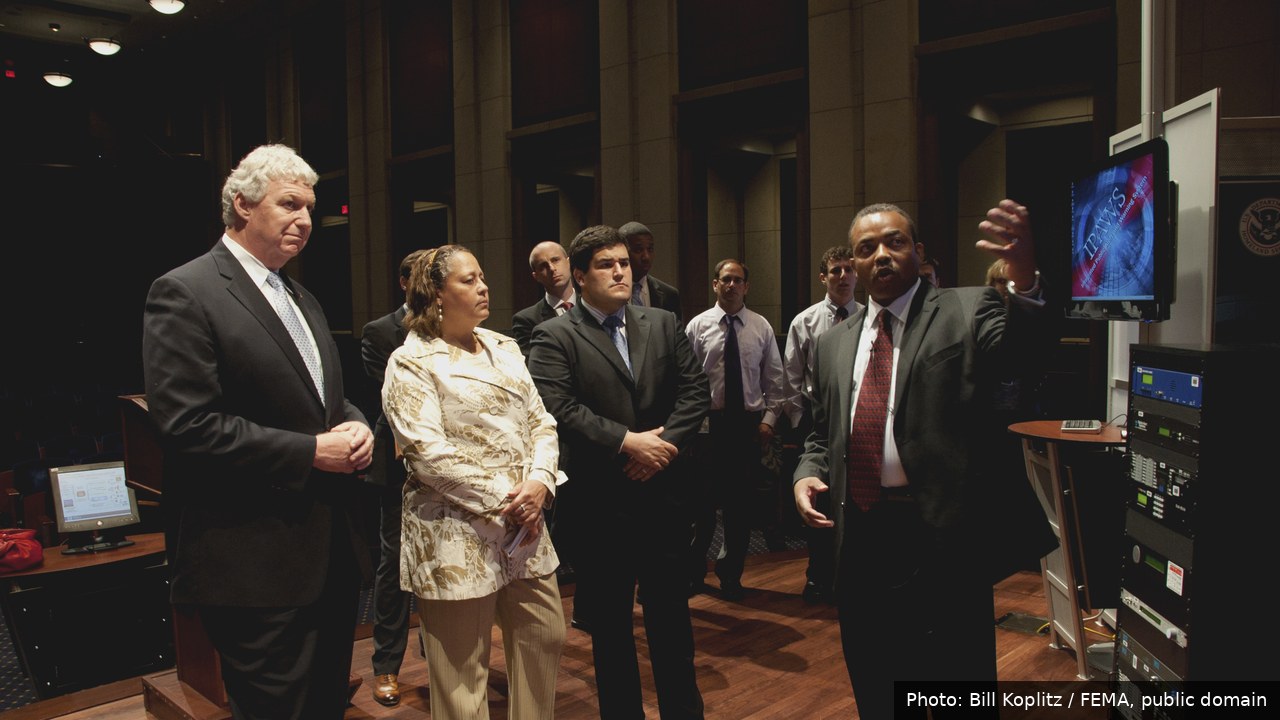
Photo: Bill Koplitz / FEMA, public domain (IPAWS demonstration on Capitol Hill, Sept. 2010 file photo; cropped and credit added)